David Garrett recognized as a 2026 HousingWire Insider

David Garrett recognized as a 2026 HousingWire Insider - insert image-2

The HousingWire Insiders award recognizes the leaders who keep mortgage operations moving. David Garrett is one of them. 

As DocMagic’s Director of Integration and Technical Services, David leads the teams responsible for the integrations our partners, lenders, investors, and vendors rely on every day.  

His work helps keep critical connections running smoothly, supporting efficient loan workflows from application to closing and beyond. 

Over the past 12 months, David has also helped move the industry forward through his work with MISMO. He serves as vice chair of both the Origination and eMortgage Communities of Practice, contributing to the standards that help lenders, technology providers, and business partners stay aligned.  

David also helped advance the standards that made trust eNotes possible, closing a long-standing gap and expanding what fully digital mortgage transactions can support.  

Congratulations to David on this well-deserved recognition. 

Read the full story here!


Categories
Title Alias (URL Slug)
david-garrett-recognized-as-a-2026-housingwire-insider

State and Investor Variations in Closing Docs: Why Lenders Can’t Afford to DIY

Blog_ State & Investor Variations - insert image 

Every closing package starts with the same federal foundation. TRID, RESPA, TILA—these federal requirements are fixed across the board, and most lenders have them well in hand. But the federal layer is only the foundation. What comes next is where things get complicated and where lenders who are managing growth without a structured approach to document generation start adding risk they may not even be aware of. 

The variation introduced by state law and investor requirements isn't a niche problem. It's a structural one, and the patchwork processes most lenders use to manage it tend to hold right up until they don't. 

A closing package that is complete and compliant in one state can be materially deficient in another. That's not a hypothetical: it's the daily operational reality for any lender originating across multiple jurisdictions. 

Not All Closing Packages Are Created Equal 

Most lenders set out to build consistent, scalable closing processes. But as origination volume grows and loan types multiply, gaps accumulate, and state law is where the first layer of real complexity enters the picture. 

Attorney states require that a licensed attorney prepare or review closing documents, and in some cases be physically present at the table during signing/loan closing. Non-attorney states follow different rules. Eligibility for remote online notarization (RON) varies by jurisdiction. Transfer tax disclosures, rescission rights, and state-specific forms all differ (sometimes substantially) from one state to the next. 

Edge Cases Get Expensive 

Broad state-to-state differences are generally understood and, with the right infrastructure, manageable. The more dangerous territory is the edge case: the requirement that falls outside routine workflows and prompts your team to improvise rather than solve systematically. These are the situations where tribal knowledge substitutes for process, and where exposure quietly builds. 

A few examples illustrate just how specific—and how consequential—these requirements can be: 

  • Texas Section 50(a)(6). Missing or incorrect constitutional disclosures on home equity loans give the borrower the right to demand that the lender forfeit all principal and interest collected if the defect is not cured within 60 days. This isn't a fine or a slap on the wrist—it's a potential forfeiture of the entire loan's economics. 
  • Florida documentary stamp tax. Florida requires a documentary stamp tax on the note in addition to the deed, and that requirement must be reflected specifically in the closing disclosure. Miss it, and you're looking at a disclosure defect on a closed loan. 
  • Washington Consumer Loan Act disclosure. Certain loan types in Washington require a specific disclosure under the Consumer Loan Act. The form is Washington-only and has no analog in other states, which means it's precisely the kind of requirement that gets overlooked when your team is working from memory. 

These aren't obscure technicalities. They're real requirements with real consequences, and they represent only a fraction of the state-level variation your document process has to account for at scale. 

Investor Requirements Are an Entirely Separate Layer 

Once you've accounted for state law, you're not done. Investor requirements introduce a second, independent layer of complexity that sits on top of everything else. 

GSEs maintain their own uniform security instruments by state. These instruments are not identical across states, and they change regularly, sometimes without much advance notice. Correspondent investors layer on further with their own closing instructions, required language, and delivery standards. If you're managing multiple correspondent relationships, you're effectively managing multiple document standards simultaneously, each with its own update cadence. 

Acquisitions compound this. When you absorb a new team, you inherit investor relationships that may not map cleanly onto your existing workflows or document systems. Reconciling those inherited relationships falls to compliance staff who are already stretched thin. 

And when investor guidelines change, the update rarely comes with lead time. Your team either catches it proactively or discovers the gap after the fact, usually in the form of a post-purchase finding. 

When Patches Become the Process 

The typical response to this kind of complexity is incremental: append a form, add a note to a spreadsheet, rely on the one person who handled that loan type before. These manual patches address immediate problems. They are not durable solutions. 

What makes this dynamic insidious is that it compounds across both layers—state and investor—simultaneously. A patch that addresses a state disclosure requirement doesn't help you when a correspondent investor updates its closing instructions. And vice versa. The patchwork grows in parallel with your business, and the gaps within it multiply. 

The patch holds until origination volume increases, a requirement changes, or the person who knew the workaround leaves. When it fails, it tends to fail at the worst possible moment: a closing, an audit, a post-purchase review. 

The Stakes of Getting It Wrong 

Document errors in correspondent lending can trigger a repurchase demand or an indemnification obligation. Errors may also require having the borrower return and re-sign documents. An outdated state disclosure creates audit exposure. The wrong investor-specific/investor-required document surfaces as a post-purchase finding. None of these outcomes is cheap, and none is easily reversed after the fact. 

Beyond the direct costs, there's the operational drag of staff time spent manually chasing state-specific requirements or reconciling investor instructions. And the reputational cost of recurring compliance failures with correspondent partners is real, even when it's hard to put a number on it. 

The downstream cost of a document error almost always exceeds what it would have cost to get it right at the outset. That's the fundamental economics of getting document generation right. 

A Better Approach to Document Complexity 

If your team is carrying this compliance burden manually, it's not because you made bad decisions. It's because your business grew faster than your processes—a gap that widens gradually and feels manageable until it isn't. 

DocMagic's document generation engine is built around the reality that state requirements and investor guidelines are not static. Our rules-based system absorbs all transactional data to dynamically produce a compliant document package while evaluating critical transaction information at every phase of the mortgage lifecycle, from initial disclosures through closing. State-specific forms, investor-specific/investor-required documents, correspondent closing instructions: all of it is tracked and applied automatically, so you're not depending on manual patches or institutional memory to stay current. 

The result is a document process that scales with your business instead of fracturing under it. If you're ready to move beyond the patchwork, we'd love to show you how it works. 

Title Alias (URL Slug)
state-and-investor-variations-in-closing-docs-why-lenders-cant-afford-to-diy

RON Isn't for Every Loan. That's the Point.

The Lenders Roadmap to RON - Blog insert 

Remote online notarization (RON) is no longer an emergency case solution. In fact, many borrowers prefer the ability to close from home, on their own schedule, even when travel is not a factor. 

Sustaining success with RON, however, is not accidental. You get there by being deliberate about how you roll it out.

Start where RON fits best 
The most effective RON programs begin with transactions that naturally align with a digital closing environment. 

Refinance transactions often serve as the cleanest entry point, as they eliminate seller coordination and involve borrowers who already own the property. Cash‑out refinances in particular tend to benefit from the speed and convenience RON provides. 

Out-of-state purchase loans are another strong candidate. As relocation and remote work continue to drive cross‑state transactions, coordinating in‑person closings across time zones can strain borrowers and settlement partners alike. RON reduces that friction. 

Investment property loans also lend themselves well to early adoption. Investors are typically repeat borrowers who understand documentation and value efficiency, allowing lenders to sharpen their process while their team gets comfortable with it. 

In many cases, borrower preference alone can guide adoption. When a borrower actively requests a digital closing, expectations are often already aligned, leading to higher satisfaction. 

Prepare before you scale 
As RON volume grows, complexity grows with it. Jurisdictional requirements vary by state and sometimes by county, affecting authorization, identification standards, recording acceptance, notary rules, and investor overlays. You need to account for those differences. 

Internal readiness is equally important. Clear processes keep things consistent as you add volume. 

Your borrower experience also plays a critical role. Disrupted sessions frequently stem from preventable issues such as device compatibility, connectivity, or identification requirements. Getting ahead of borrower questions prevents most hiccups. 

The right partner makes scaling easier 
Addressing these considerations does not require building every safeguard internally. The right partner helps navigate jurisdictional requirements, strengthen operational readiness, and protect the borrower experience as adoption expands. 

Support that extends beyond core technology—such as state‑level compliance guidance, coordination with certified notary networks, implementation assistance, and borrower‑ready communication resources—reduces friction as volume increases. A good technology partner keeps things consistent on the legal, operational, and borrower‑facing dimensions, so scaling gets easier and doesn’t drain your team. 

When evaluating RON technology, lenders benefit from looking beyond basic functionality to factors such as geographic notary coverage, compliance expertise, implementation and training support, integration compatibility, and escalation responsiveness. 

Knowing where not to use RON is just as important 
Part of a smart RON strategy is knowing where it’s not the best fit. First-time homebuyers, complex ownership structures, or jurisdictions with unclear acceptance may be better served through traditional closings, at least initially. 

Being clear about where RON belongs, and where it doesn’t, keeps things running smoothly and borrowers trusting the process. 

Discipline drives long‑term advantage 
A well‑structured RON strategy strengthens a lender’s competitive position when applied intentionally. Starting with the right loan types builds momentum and gives your team confidence. It’s a natural path from a small pilot to something much bigger. 

For a deeper framework: 
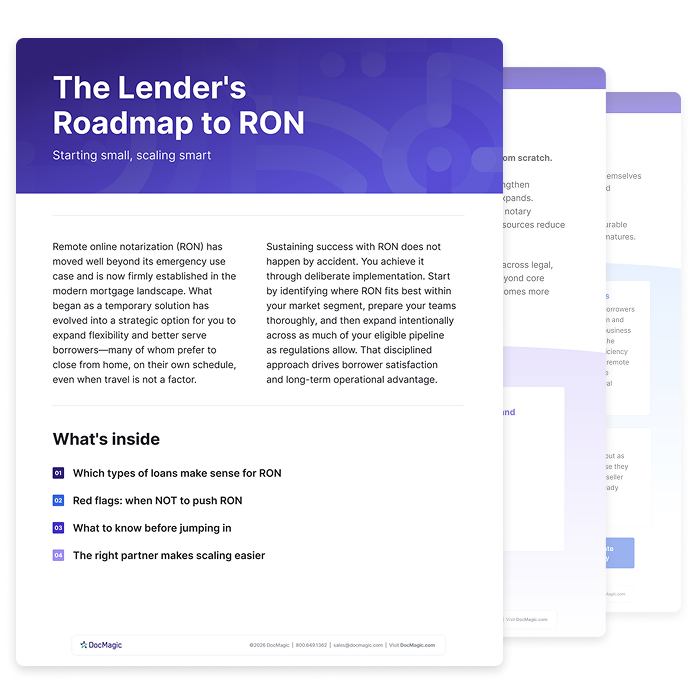
The lender’s roadmap to RON: Starting small, scaling smart outlines how to evaluate loan types, confirm readiness, and expand remote online notarization with confidence. 

Get the guide to explore the full roadmap. 


Categories
Title Alias (URL Slug)
a-disciplined-approach-to-scaling-remote-online-notarization

Inside the eVault: The Foundation of Digital Asset Management


eVault blog insert

Across financial services, the definition of a transferable asset is changing. What once required a physical document, a wet signature, and a FedEx envelope can now move as a fully digital asset — validated, tracked, and delivered without ever leaving a controlled digital environment. The eVault is what makes that possible. 

A digital asset does not stop moving after it is signed. It travels from origination through closing, registration, and on to investors, servicers, and every hand it passes through needs to trust what they are receiving. eVaults are the connective tissue holding that entire path together. 

The eNote is what first made that infrastructure necessary. An eNote is an electronic promissory note built on MISMO's SMART Doc® format, combining structured data and visual presentation into a single tamper-evident file, that serves as the legal authoritative copy. From the moment it is signed, every step in its lifecycle runs through eVaults. 

How it works 
When an eNote enters an eVault, the first thing that happens is validation. Before the asset is accepted, it goes through active checks against MISMO standards, catching errors at the point of entry rather than discovering them at post-closing or investor delivery. Once accepted, the eVault is integral to processing updates from MERS to identify the authoritative copy and has a critical role in managing the eNote throughout its lifecycle. 

As the loan status changes, the eVault is the mechanism for initiating the corresponding registry updates. The MERS eRegistry reflects what eVaults report, serving as the industry-wide record of controller and location. The MERS record follows the loan through every transfer, servicer update, and status change from origination through paid-off; status change from origination through payoff or other loan outcomes. When the loan is ready for delivery, the eVault sends a copy directly to the investor’s eVault, bypassing manual certification, shipping, and review steps that once added days to the process. Every sale/transfer, controller change, registry update, and delivery leaves behind a permanent record in the MERS eRegistry, and that audit trail is what makes the chain of custody defensible in due diligence, regulatory examination, and investor review. 

Expanded Use Cases  
The same eVault foundation that supports first-lien mortgage assets extends well beyond them.

Home equity lending was the next to follow. eHELOCs can be originated, signed, vaulted, and registered with the MERS eRegistry as fully digital assets. In June 2025, DocMagic and Truliant Federal Credit Union completed the mortgage industry's first eHELOC registration with the MERS eRegistry, demonstrating that other lending instruments can move through the same fully digital workflow. With more than 24 states and Washington D.C. having adopted UCC Article 12, the legal framework enabling electronic transferable records, that milestone is quickly becoming a model for broader market adoption. 

There are other asset classes that don’t use a centralized registry like MERS.Asset classes like auto loans, solar panel agreements, and commercial leases have lacked the infrastructure to move as defensible digital instruments. Instead of tracking Control and Location through MERS, DocMagic’s SmartSAFE® eVault technology tracks security interest under UCC Article 12, giving lenders a defensible chain of custody for signed assets that have never had a registry-backed system behind them.  

DocMagic’s SmartSAFE eVault technology  
MISMO awarded DocMagic eVault System Certification for SmartSAFE after independently evaluating 192 test cases, confirming the technology performs across different architectures and workflows. The certification joins three others DocMagic has earned across the broader digital asset lifecycle: eClosing System, RON, and SMART Doc Validation Rules. 

From origination through closing, registration, and investor delivery, the eVault is the connective tissue holding the digital asset lifecycle together. Every digital asset is only as strong as the system maintaining it. DocMagic built its eVault technology on the same compliance-first foundation that has shaped its approach to the digital mortgage operations from the beginning, and that continuity is what gives SmartSAFE its credibility across every asset class it supports today. 

Learn more about how DocMagic's SmartSAFE eVault technology supports the full digital asset lifecycle at docmagic.com/smartsafe. 


Categories
Title Alias (URL Slug)
inside-the-evault-the-foundation-of-digital-asset-management-tag-evault

DocMagic Earns 2026 MortgagePoint Tech Excellence Award


DocMagic-1

DocMagic has been recognized with the 2026 MortgagePoint Tech Excellence Award, honoring the most innovative technology providers in the mortgage industry. 

The award highlights DocMagic’s continued evolution from document generation provider into a complete digital mortgage platform. Today, our proprietary platform spans document generation, automated compliance, eSignatures, eClosing, and eVaulting. Lenders, settlement service providers, investors, and servicers use it to cut costs, close faster, and scale their digital operations. 

Momentum continues to build 

DocMagic has driven measurable adoption of eClosing technology, contributing to more than 850 million eSignatures and over 3 million eClosings across the platform. 

Over the last year, eClosing volume grew an estimated 58.09% year over year. eNote generation climbed 150.58%, and eNote registrations rose 95.67%. These results reflect a broader industry shift from digital exploration to sustained operational deployment, closely tied to DocMagic's consultative approach to implementation, utilization, and long-term customer success. 

DocMagic’s commitment to innovation never wavers.  That commitment shows up in recent U.S. patents, MISMO certifications across eClosing, RON, and eVault systems, and milestones like enabling the industry's first eHELOC registration with the MERS® eRegistry. 

DocMagic remains focused on building reliable, enterprise-ready technology that keeps lenders ahead of what's next.

Read more: https://themortgagepoint.com/2026/06/15/meet-this-years-mortgagepoint-tech-excellence-award-recipients/


Categories
Title Alias (URL Slug)
docmagic-earns-2026-mortgagepoint-tech-excellence-award
RSS Feed

One provider for all your mortgage technology.